


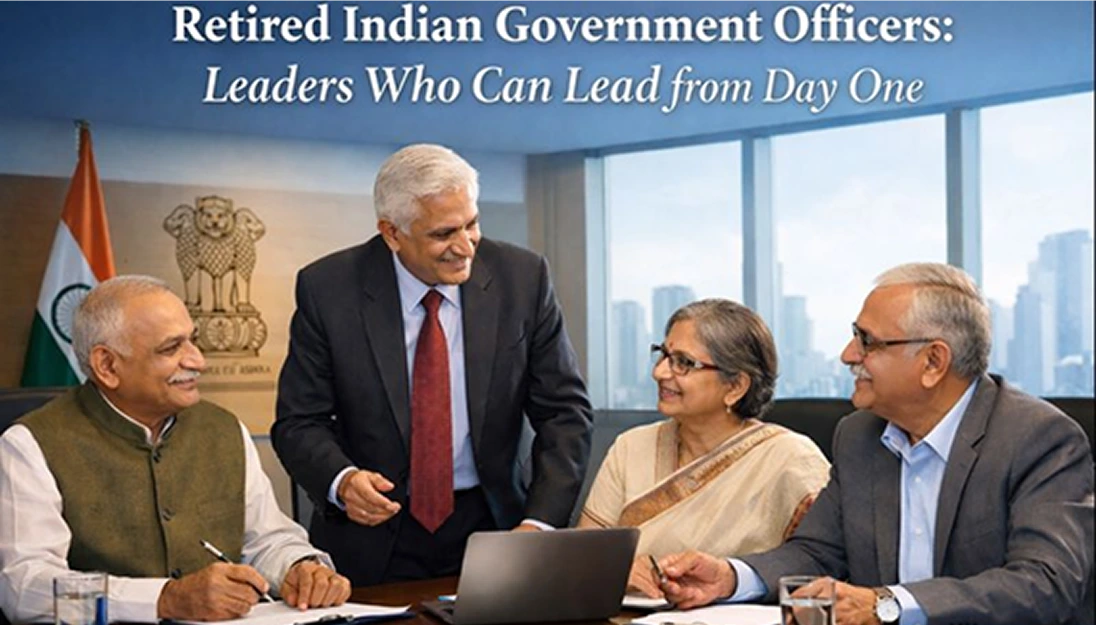
Leadership That Works From Day One
A mid-sized manufacturing company in Gurugram was facing a severe challenge a few years back. A surprise examination by the government threatened to stop their operations completely. They were behind on licenses, had a lot of compliance difficulties, and the management team was going in circles.
In a last-ditch effort, they hired a former IAS officer as a strategic advisor. He strolled into the office on his first day, looked over the papers while sipping his chai, made a few clandestine phone calls to old acquaintances in the ministries, and made a clear plan of action. The problems were fixed in a matter of weeks, manufacturing started up again, and the corporation didn't have to pay big fines.
No protracted onboarding or steep learning curve, just calm, strong leadership that turned chaos into order. This isn't simply a one-time story, it's a look at the untapped potential of retired Indian government officials who are ready to lead from day one when they move to the private sector.
The Corporate Leadership Gap
Companies today sometimes have trouble with inexperienced CEOs or long training periods for new personnel because the business world moves so quickly.
But retired Indian government officials, like IAS, IPS, IFS, and other high-ranking bureaucrats, have something special to offer: decades of real-world expertise in management, policy execution, crisis management, and working with stakeholders.
These officers have dealt with big budgets, complicated rules, public complaints and led teams through national problems like disasters or economic transformations. They are at the height of their professional wisdom when they retire, which is usually about age 60.
Skill Sets That Matter in Business
Think about the skills they have. They have 30 to 35 years of experience in administration, which means they have specialized knowledge of bureaucracy. This makes them ideal for businesses that need to get government approvals, follow rules, or work with both public and private partners.
Their ability to handle crises, which they learned in high-pressure situations like law and order concerns or emergency responses, directly helps businesses avoid risks
Regulatory compliance is another strong point; many retired IAS officers have made policies themselves, so they can easily help businesses get past the red tape.
Moreover, they have huge networks that connect them to people in different ministries, states, and businesses. These networks offer doors that no new MBA graduate could.
Where Retired Officers Fit in Corporate India
Many retired Indian government officers serve on boards, as independent directors, or as advisors in fields like banking, healthcare, infrastructure, and manufacturing.
Ex-bureaucrats in corporate India used to be unusual, but now they are necessary for long-term progress.
Companies that hire retired government officials say they make decisions faster, have greater communication with the government, and follow the rules more strictly.
In a time when ESG (Environmental, Social, and Governance) norms are very important, their honesty and dedication to public service stand out.
Why They Can Lead From Day One
These ex-officers are experienced leaders who earn respect right away, unlike rookie executives who need time to acquire a reputation.
They have been in charge of districts, states, or central ministries and have managed thousands of employees and teams of people from different backgrounds.
Strategic planning, making decisions without bias, and having a long-term vision are all things that bureaucracies can teach us about leadership that we can use in business.
Hiring experienced leaders like retired IAS officers can make a big difference for new businesses or businesses that are growing. It can lower the high failure rates that frequently happen when management is new.
Challenges in Transition
Of course, things don't always go smoothly when you change. Compared to public service, corporate culture can seem more focused on making money.
Some officers would rather work for the government when they retire, like on tribunals or commissions.
But for those who choose to work in the private sector, the rewards are huge, both in terms of money and effect. Many people make a lot of money, more than just pensions, while also helping to improve the country in new ways.
Why Businesses Should Act Now
It is evident for firms that hiring retired government workers is a good idea. It is not about how old you are, it is about the experience you can't learn in school.
These officials can help the private sector thrive and innovate in a way that is good for business as India works toward Viksit Bharat by 2047.
And In The End…
This is the time for business leaders who want to identify people who are ready to lead, especially retired Indian government officers who want to start their second inning in corporate.
The skills and knowledge of retired IAS officers, IPS veterans, and other former government officials are a national treasure that should be used more effectively.
In the end, retired Indian government officers aren't just retiring; they are changing the way leaders work. They step in and lead well from day one, delivering stability, insight, and results because they have a proven track record.